AI designed toys are changing how children play, learn, and interact with products at home. Some respond to spoken questions, while others adjust puzzles or stories to a child’s progress. The experience can feel personal. It can also raise practical questions about privacy, screen time, and how much adult guidance is needed.
For global buyers, an appealing feature is only part of the decision. Age suitability, clear instructions, durable materials, and reliable after-sales support matter too. Buyers should check product documentation and confirm that safety and privacy requirements are appropriate for each target market. Requirements vary. A polished demo alone is not enough.
This guide introduces ten AI designed toys and the details that help distinguish them, from interactive companions to creative learning kits. It considers how each product works, who may enjoy it, and what buyers should verify before choosing. Look closely at setup, connectivity, language options, and whether core play remains useful without an internet connection. Small details matter. No shortlist can predict every child’s needs, and product claims deserve careful review. That part is easy to overlook. The goal is a more informed comparison—not the assumption that every smart feature makes a toy better.
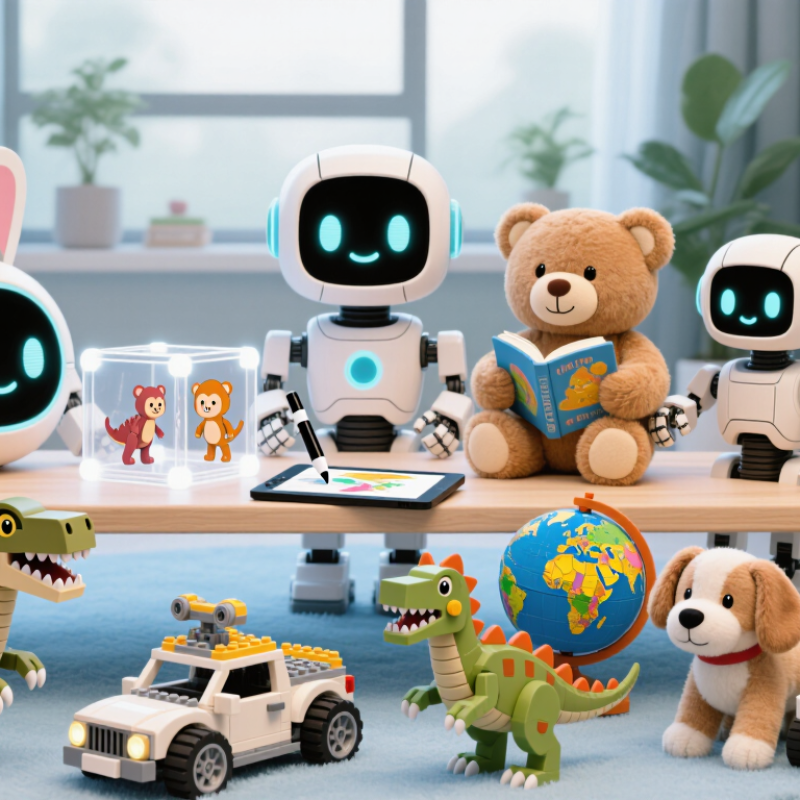
An AI-designed toy is a physical plaything whose form, features, or development process was meaningfully shaped with artificial intelligence. That does not necessarily mean the toy contains a chatbot, microphone, or electronic brain. AI might help generate body shapes, test color combinations, or adapt a puzzle’s difficulty for different ages. Picture a small wooden creature with rounded ears, a broad base, and smooth edges: software may suggest the shape, but people still need to judge whether it feels sturdy and comfortable in a child’s hands.
The label can be fuzzy. A toy with a digital feature is not automatically AI-designed, and using AI for a quick sketch does not make every design decision intelligent. Buyers can ask what AI contributed, which parts were reviewed by human designers, and how the finished toy was tested. Practical details matter: seams should not catch small fingers, paint should resist ordinary wear, and moving parts should feel secure. These checks are more meaningful than a clever product description.
Good AI-assisted design should solve a play problem, not merely add novelty. A shape-generation tool might help create large, easy-to-grip blocks; feedback from children and caregivers can reveal whether they are actually easy to use. Still, test results do not capture every child or setting. That limitation deserves attention. Clear information about materials, intended age range, care, and testing helps global buyers compare toys with greater confidence.
Artificial intelligence changes toys less through spectacle than through timing. A plush companion can notice a pause, ask a follow-up, or soften a story when attention drifts. A coding robot might simplify a puzzle after repeated mistakes. A drawing kit could turn a spoken idea into a sketch. These features make play feel responsive. They also change the designer’s task: teaching a toy when not to speak. More interaction is not automatically better. Quiet moments matter.
Market context matters, too. Circana reported that toy sales across 12 tracked global markets fell 7% in 2023, though they remained 13% above 2019. That suggests buyers still value lasting play, not novelty alone. Common Sense Media’s 2024 survey found that 70% of U.S. teens had used at least one generative AI tool. This signals familiarity with conversational technology, not proven demand for AI toys. I would not treat it as a forecast. Buyers can test whether a toy responds sensibly in a noisy room, works without constant internet access, and clearly explains what information it retains. Test it. A toy that repeatedly mishears a child can feel more like a chore than a companion.
Ten AI-designed toy concepts can span plush storytelling, coding robots, STEM construction sets, jigsaw puzzles, art kits, pretend-play kitchens, musical toys, board games, sensory play objects, and outdoor activity toys. Each category solves a different play need: a plush character might respond with changing stories, while a construction set could offer adjustable challenges. Small details matter.
Circana reported that toy sales across 12 tracked global markets fell 7% in 2023, yet remained 17% above 2019 levels. That context favors designs with lasting play value, not novelty alone. AI tools can help designers test shapes, colorways, and age-based difficulty. A puzzle might use larger pieces for younger children; an outdoor target game could offer several skill levels. These are design possibilities, not proof of better play.
For global buyers, each concept needs practical review before production. Check age grading, material durability, cleanable surfaces, and securely enclosed batteries. For connected toys, collect as little personal data as possible and explain any recording functions clearly. A robot that works only with a stable internet connection may frustrate families. Test prototypes with children and caregivers across different settings; AI-generated designs can miss awkward grips, confusing instructions, or cultural differences.
When comparing AI-designed toys, start with the child’s age and play habits, not the feature list. For younger children, check whether buttons, prompts, and spoken replies are easy to understand. Older children may enjoy open-ended questions or creative challenges, but adult guidance can still matter. Common Sense Media’s 2021 Census found that U.S. children aged eight and under averaged 2 hours and 27 minutes of screen media daily. That figure measures screen use, not the quality of AI play. A toy that encourages conversation away from a screen may suit some families better.
Compare functions through a real play test: ask the toy to tell a short story, answer a simple question, and repeat an instruction. Notice delays, confusing replies, and whether play still works without a network connection. Small details matter. Check volume controls, washable surfaces, battery life, and clear privacy settings. Circana reported that toy sales across 12 major markets fell 7% in 2023, making durability and replacement costs relevant to value. Compare the purchase price with expected use, required subscriptions, and likely accessory costs. A long feature list can look impressive; it may not keep a child interested. Even a careful comparison has limits: children’s preferences change, and published market data cannot predict one child’s experience.
AI-designed toys can move from sketch to prototype quickly, but global buyers still need evidence behind each safety claim. A soft robotic pet may contain a battery, small detachable accessories, and sensors that need separate checks. Check age grading, accessible parts, mechanical strength, flammability, and chemical test reports for the intended market. Small details matter. Reports should match the exact materials, factory, and finished model being ordered, not a similar sample.
Requirements differ across destinations, so confirm applicable product rules and labeling with qualified local specialists before production. Keep technical files, risk assessments, supplier declarations, test results, and traceable batch records together. For connected toys, ask what voice or play data is collected, where it is stored, and how families can delete it. Avoid collecting data that the play experience does not need. It sounds obvious, yet teams sometimes discover this too late.
Sourcing quality also depends on repeatable controls. Approve a production sample, then define limits for seams, paint, battery compartments, sound levels, and packaging in writing. Arrange inspections at a risk-appropriate stage, and require approval before material or component substitutions. Ask suppliers to explain corrective actions with photos and dates, not just promises. A low quote can hide rushed testing or unstable components. I would still leave room for human judgment; checklists cannot catch every awkward edge or confusing instruction. Buyers should assess toys with caregivers and children under safe, supervised conditions. That matters.
Artificial intelligence meaningfully shaped its form, features, or development. It does not need a chatbot or electronic parts.
Not necessarily. Ask what AI contributed and which decisions people reviewed.
It can suggest shapes, colors, or adjustable puzzle difficulty. Larger pieces may help younger children grip them.
No. Children and caregivers should test whether the toy feels clear, sturdy, and enjoyable. Results can still miss things.
Check age guidance, small detachable parts, seams, paint durability, and mechanical strength. Small details matter.
Request reports for the exact materials, factory, and finished model. Keep test results and batch records together.
Ask what data the toy collects, where it is stored, and how families can delete it. Collect only what play needs.
Approve a sample and set written limits for seams, paint, batteries, and sound. Require approval before substitutions.
No. Observe supervised play with children and caregivers. I would still question confusing instructions or awkward grips.
AI designed toys combine artificial intelligence with traditional play to create more responsive, adaptive, and interactive experiences. Their features may include voice interaction, educational guidance, customizable challenges, or play patterns that adjust to a child’s interests and abilities. Across categories such as learning, creative play, games, and interactive companions, these toys can offer different levels of engagement, so buyers should consider the intended age group, ease of use, educational or entertainment value, and overall cost.
For global buyers, selecting an AI toy also means looking beyond its features. Check age guidance, product quality, data and privacy practices, and the clarity of instructions, while confirming that relevant safety and compliance documentation is available for the intended market. Comparing these factors alongside durability, support, and sourcing options can help buyers choose products that are suitable, dependable, and valuable for children and families.