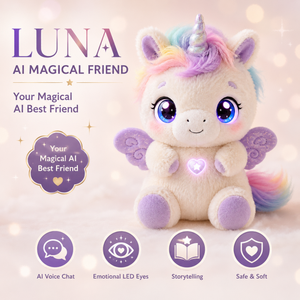
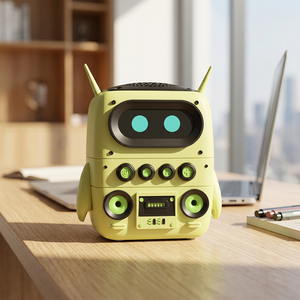

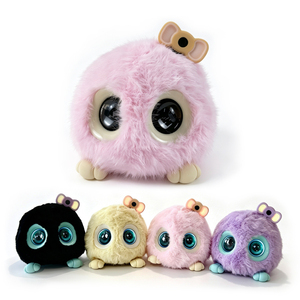
Strategic Engineering Whitepaper: Sourcing CE Certified AI Toy Content Creation Systems
The global intelligent smart toys and AI companion devices ecosystem has fundamentally shifted from reactive, pre-recorded audio chips to dynamic, generative content pipelines. According to recent market intelligence reports, the global smart toy industry will exceed USD 19.3 Billion, driven by parents and educational institutions seeking conversational agency, personalized STEM curricula, and emotionally intelligent companions. For procurement directors, category managers, and consumer electronics brand founders, sourcing an AI toy is no longer merely an exercise in plastic injection or fabric stitching. It requires navigating the complex intersection of embedded hardware acoustics, real-time safety content guardrails, cloud LLM moderation, and regulatory compliance across Europe, North America, and Australia.
Crucial Procurement Takeaway: A successful AI interactive toy project succeeds or fails at the acoustic and firmware integration layer. Placing a standard microphone inside dense PP cotton without custom Helmholtz acoustic chambers degrades speech recognition accuracy by up to 48%, rendering even the most advanced generative models useless.
Standardized B2B Development Routes & Cost Structures
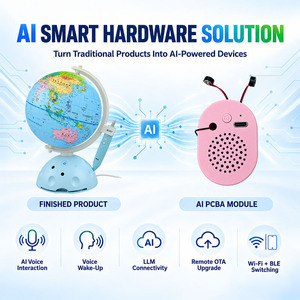
To prevent massive non-recurring engineering (NRE) overruns, AIbottoy Hub structures all B2B OEM/ODM engagements into four transparent development archetypes based on the proven Tuya IoT edge-to-cloud ecosystem:
| Route Option | System Architecture | Customization Scope | Target Timeline | Indicative Cost (USD) | Commercial Viability |
|---|---|---|---|---|---|
| Option 01: Existing APP + Solution | Standard Tuya AI module, pre-tuned acoustics, ready-made companion app | Plush skin design, embroidery, logo, custom boot chime, retail box | 25–30 Days Sample 15–20 Days Bulk |
Sample: $350–$400 Standard MOQs |
Lowest Risk / Fast Launch |
| Option 02: Custom Face / LED Mold | Established Tuya core + Custom structural injection tooling | Expressive LED eye matrices, bespoke plastic facial skeletons, custom housing | 40–50 Days Tooling 20 Days Mass Assembly |
Tooling: From $10,000 Unit NRE Amortized |
High Character Brand IP |
| Option 03: Tuya SDK to Client App | Embedded hardware connects to client's existing proprietary mobile app | Tuya OpenAPI & Native Mobile SDK bridging; custom device UI within client app | Evaluated based on App codebase maturity | Integration Fee: From $12,000 |
Established Tech Brands |
| Option 04: Fully Branded Bespoke App | White-labeled iOS & Android apps published under buyer's developer accounts | Complete UI skinning, custom onboarding, proprietary virtual rooms and daily tasks | 35–45 Days Software Parallel with Hardware |
App Solution: From $14,000 |
Complete Brand Ownership |
Future Procurement Trends: Where the AI Toy Market is Headed (2025–2030)
B2B procurement professionals must anticipate consumer and regulatory expectations three to five years ahead. Our Shenzhen R&D team tracks five macro shifts transforming the wholesale AI toy sector:
1. Edge-First Hybrid Content Synthesis
Cloud dependency increases server operating costs and creates vulnerability to Wi-Fi outages. Next-generation buyers are requesting hybrid architectures: local microcontroller chips running offline quantized SLMs (Small Language Models) for essential speech recognition, switching to cloud LLMs only for open-ended storytelling.
2. Multimodal Spatial & Emotional Perception
Simple voice Q&A no longer captivates young demographics. Toys are integrating miniature micro-cameras, low-power ToF sensors, and capacitive touch arrays. Toys can visually identify a child's hand-drawn sketch, interpret facial sadness, and adapt their vocal tone dynamically.
3. Zero-Knowledge Privacy Architecture
With aggressive enforcement of the European Union AI Act and FTC COPPA guidelines, modern AI toys must strictly prevent persistent child voice logging. Importers increasingly specify volatile memory buffers that process speech in RAM without writing identifiable recordings to non-volatile flash storage.
4. Modular Hardware-to-Plush Separation
Sustainable toy mandates and maintenance requirements favor modular designs. Sourcing teams are standardizing on snap-in electronic cores that can be removed in seconds, allowing parents to safely machine-wash the plush exterior and simplifying battery recycling at end-of-life.
Comprehensive Product Development Trends in AI Content Creation
Content generation within smart toys has evolved beyond repetitive scripted MP3 files into self-adjusting pedagogical experiences. Modern AI toy engines leverage dynamic system prompts and multi-turn dialogue memory, allowing the toy to build persistent relationships with children over months rather than days.
1. Pedagogical Personalization & Cognitive Progression
In our smart educational companion robots, the underlying AI dynamically tracks vocabulary acquisition. If a child demonstrates mastery of foundational vocabulary, the toy shifts from basic phonics questions to multi-step contextual comprehension puzzles. This content generation occurs autonomously inside the cloud dialogue pipeline, adhering to calibrated age-tier guardrails (e.g., ages 3–5 vs. 6–8).
2. Safe Gamified Social Feeds & Virtual Pet Mechanics
Hardware engagement rates skyrocket when paired with structured digital companion apps. Our standard Tuya-based OEM app ecosystem features virtual rooms, daily interaction tasks, feeding sequences, and social friend codes. This ensures repeat usage while preventing toxic external communications through strictly closed, monitored peer networks.
Factory Truth on Custom LLM APIs: Many prospective clients ask to link their own private OpenAI or custom API keys directly to production hardware. As a professional manufacturer, we state clearly upfront: all our commercial turn-key production runs utilize the proven Tuya internal AI infrastructure. Bypassing this framework introduces latency, broken OTA protocols, and server outage risks that compromise your product. Knowing these architectural realities early prevents costly software restarts.
Deep Dive: Regulatory Standards for CE Certified AI Toys in the EU Market
Entering the European single market demands total compliance with harmonized directives. Sourcing an AI toy without rigorous pre-certification documentation can lead to customs seizures, distributor bans, and severe administrative fines under EU market surveillance frameworks:
1. EN 71 Series (Toy Safety): EN 71-1 governs mechanical and physical properties (preventing small parts choke hazards, battery compartment security via screw locks). EN 71-2 checks flammability risks of soft fabrics and plush stuffing. EN 71-3 strictly regulates heavy metal migration (lead, cadmium, barium) in silicone coatings, plastics, and conductive paint.
2. EN 62115 (Electric Toys Safety): Covers electrical hazards, verifying that smart toys powered by rechargeable lithium-ion cells remain well below dangerous surface thermal limits during heavy wireless streaming, preventing thermal runaway or burning risks.
3. Radio Equipment Directive (RED 2014/53/EU): Crucial for all Bluetooth Low Energy (BLE) and 2.4GHz Wi-Fi modules. Requires formal EMC (Electromagnetic Compatibility) testing (EN 301 489) and RF spectrum efficiency testing (EN 300 328) to confirm non-interference with surrounding equipment.
4. Lithium Battery Safe Transport (UN 38.3 & MSDS): Air freight carriers (DHL, FedEx, airline cargo) reject battery-integrated electronic shipments lacking valid UN 38.3 test summaries, drop tests, and thermal vibration documentation. AIbottoy Hub supplies pre-cleared transport documentation packs with every wholesale delivery.